
Which prop firm is the cheapest to challenge? It sounds like a simple question, but the price on the sales page rarely tells the full story. Activation fees, monthly billing, resets and refund rules all change what you end up paying.
This guide looks past the sticker price. We compare entry fees across forex and futures firms, add up the true cost of reaching a funded account, and show how resets and refunds shift the ranking. By the end, you will know how to price any challenge before you pay for it.
Prices move with promo codes, so treat every figure below as a snapshot and confirm it at checkout.
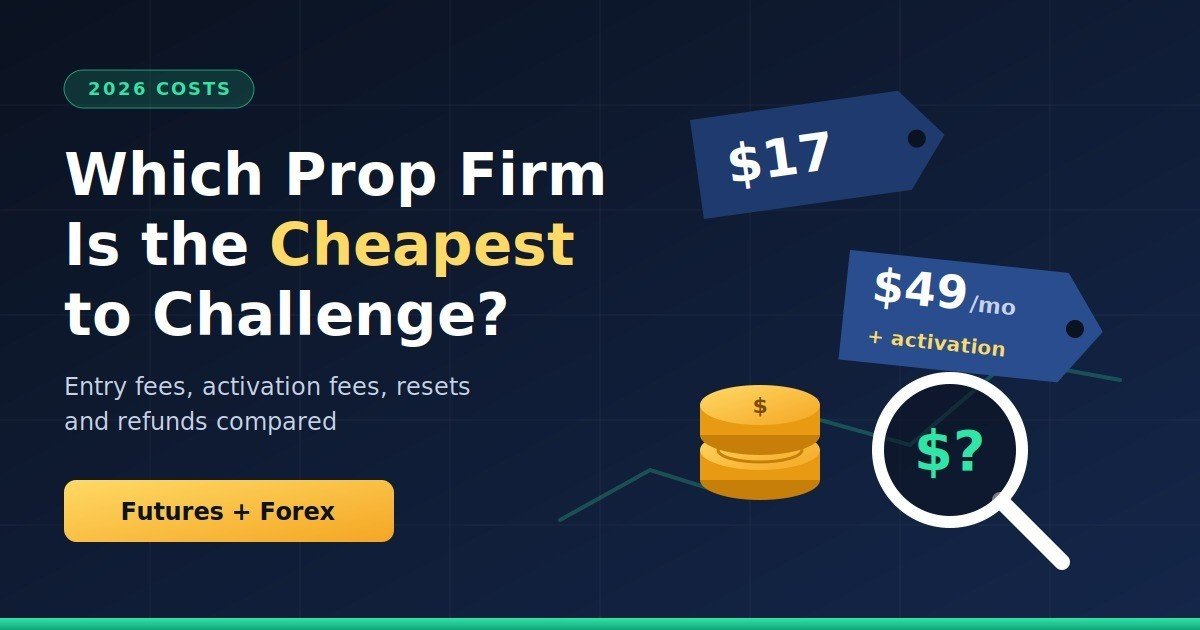
Which Prop Firm Is the Cheapest to Challenge?
It depends on the market and on how fast you pass. Based on the numbers above:
- Forex and CFD, by entry price: Maven Trading leads at $17 for a $5K account, with RebelsFunding and FundingPips close behind.
- Futures, by total cost on a 50K account: Tradeify Select and MyFundedFutures sit near $105 to $126 with no activation fee.
- Futures, on a deep promo: Apex can land lower, but only once its activation fee is added back in.
- Futures, if you pass quickly: Topstep’s No Activation Fee path is $95 for a single month.
The honest answer is that the cheapest challenge is the one you pass with the fewest attempts. A slightly higher fee with fair rules often beats a bargain you have to buy twice.
Cheapest Forex and CFD Challenges (Around $5K)
These are the lowest listed prices for a small account, based on firm pages and comparison sites checked in recent weeks.
| Prop Firm | Account | Listed Price | What to Know |
|---|---|---|---|
| Maven Trading | $5K, 3-Step | $17 | Lowest standard fee, but drawdown is tight |
| RebelsFunding | $5K | $28 ($20 with new-user code) | Static drawdown, no activation fee |
| FundingPips | $5K, 2-Step Pro | $29 | Cheapest 2-step from a major name |
| FundedNext | $5K, Stellar Lite | $32.99 | Fee refunded with your third reward |
| The5ers | $5K, High Stakes | $35 | Popular 2-step option |
| Goat Funded Trader | $5K, 2-Step Standard | $36 (promos go lower) | Fee refundable on first profit withdrawal, per the firm’s terms |
| FTMO | $10K, 2-Step | $102 | Higher price, longer track record |
Some firms advertise even lower. Blue Guardian lists a $10 instant account, and a few newer names go as low as $1 to $5. Read those offers closely. A near-zero entry fee usually means a tiny account, restricted rules, or a bigger fee charged after you pass.
Cheapest Futures Challenges (50K Accounts)
Futures pricing is where the headline number misleads most often.
| Prop Firm | Evaluation Cost | Activation Fee | Notes |
|---|---|---|---|
| Apex Trader Funding | $197 list (EOD), often 80 to 90% off | $59 to $139 on standard plans, $0 on No Activation Fee variants | One-time fee since the March 2026 overhaul, 30 days to hit the target |
| Topstep | $49 per month | $149 (Standard Path) | The No Activation Fee Path costs $95 per month with $0 activation |
| MyFundedFutures | About $105 to $126 one-time | $0 | Pricing varies by plan |
| Tradeify Select | $107 one-time (as of July 2026) | $0 | Flex plan has no daily loss limit |
| Take Profit Trader | Varies by plan | $130 (code NOFEE40 waives it) | Activation is the hidden cost here |
One warning on Apex. Sources disagree on the exact activation figure, with different pages quoting $59, $79, $99 or $139 depending on the plan and drawdown type. Check the amount shown at checkout before you buy.
What is the Total Cost to a Funded Account
Here is the same 50K futures account, priced to the finish line if you pass on your first try.
| Route | Calculation | Total |
|---|---|---|
| Apex EOD, 90% promo | About $20 to $25 + $99 to $139 activation | About $120 to $165 |
| Topstep Standard, 1 month | $49 + $149 | $198 |
| Topstep Standard, 2 months | $98 + $149 | $247 |
| Topstep No Activation Fee, 1 month | $95 | $95 |
| Tradeify Select | $107 + $0 | $107 |
| MyFundedFutures | About $105 to $126 + $0 | About $105 to $126 |
Topstep is the interesting one. The No Activation Fee path stays cheaper than the Standard Path for up to three months. After that, the Standard Path wins. So pick based on how fast you expect to pass.
Why Resets Change the Ranking
A challenge fee is not a one-time cost if you fail. Multiply it.
At $29, three attempts on a $5K account cost $87. At $102 for a $10K FTMO challenge, three attempts cost $306. Subscriptions add up even faster, since every extra month is another bill.
Refunds soften this, but read the conditions. FundedNext, for example, returns your fee only after you pass and withdraw rewards. On Stellar 2-Step, the refund comes with your first reward. On Stellar 1-Step and Lite, it comes with your third. If you reset, the refundable amount matches your latest reset fee, not your original purchase. And the $25 cTrader or Match-Trader platform fee is not refunded.
A refund that depends on passing is a bonus for winners. It does nothing for traders who fail.
Futures vs Forex: Which Costs Less?
Futures evaluations often show lower sticker prices and bigger accounts. The tradeoff is the extra layers: activation fees, market data, and platform costs. Topstep’s live account, for instance, carries a separate data cost after you move beyond the funded stage.
Forex and CFD firms tend to have simpler fee structures, with no activation fee at many of them. You still pay through spreads and commissions, and small accounts can carry tight drawdown limits.
So neither side wins outright. The cheapest option depends on which market you can trade well.
Does a Cheap Challenge Mean It Is Easier to Pass?
No. Price and difficulty are separate things. A $17 account can come with a 3% static drawdown and a 2% daily limit. That is little room for a normal trading day, especially on volatile pairs. A $110 account with a looser drawdown may cost you less in the end because you pass sooner.
Before buying, compare the rules side by side:
- Profit target
- Maximum daily loss
- Maximum overall drawdown
- Trailing or static drawdown
- Minimum trading days
- Time limit
- News and weekend restrictions
- Leverage
- Reset fees
- Activation fee
- Data and platform fees
- Payout rules and refund conditions
Fit matters more than price. A cheap challenge you cannot pass is the most expensive one you can buy.
Can a Prop Firm Passing Service Lower Your Total Cost?
If you have failed a few attempts, run the numbers. Five resets at $100 each is $500, and that is before the stress.
A prop firm passing service charges one fee in exchange for support through the evaluation. That can cost less than a string of failed attempts, but only if it is allowed under your firm’s rules and the terms are clear. Read how to judge one in our prop firm passing service review before you pay anyone.
We Pass Prop Firm works with firms including FTMO, FundedNext, The5ers, Fintokei, Lucid Trading and E8 Funding. The service uses a one-time fee with no subscriptions and offers a 100% pass guarantee and a 30-day completion guarantee, with the terms available in writing before you commit. Always confirm that third-party help complies with your specific prop firm’s account rules.
Ready to pass you prop firm challenge? Sign Up and Get Started today.
Frequently Asked Questions
1. Which prop firm is the cheapest to challenge?
By listed entry price, Maven Trading is lowest for small forex accounts at $17 for $5K. For a 50K futures account, Tradeify Select and MyFundedFutures sit near $105 to $126 with no activation fee, and Apex can be cheaper on a deep promo.
2. Is there a free prop firm challenge?
A few firms advertise $1 to $5 entries. Most of them shift the real cost to a fee after you pass or restrict the account heavily. Read the full fee schedule first.
3. Are prop firm challenge fees refundable?
Sometimes. Many firms refund the fee only after you pass and request payouts, and the timing varies by program. Most futures firms treat evaluation fees as non-refundable.
4. What is an activation fee?
A one-time charge some futures firms apply after you pass, before your funded account opens. Apex, Topstep (Standard Path) and Take Profit Trader all use one. Promo codes usually do not reduce it.
5. Is the cheapest challenge the easiest to pass?
No. Small, cheap accounts often have tighter drawdown limits. Compare the rules, not just the price.
Leave a Reply